
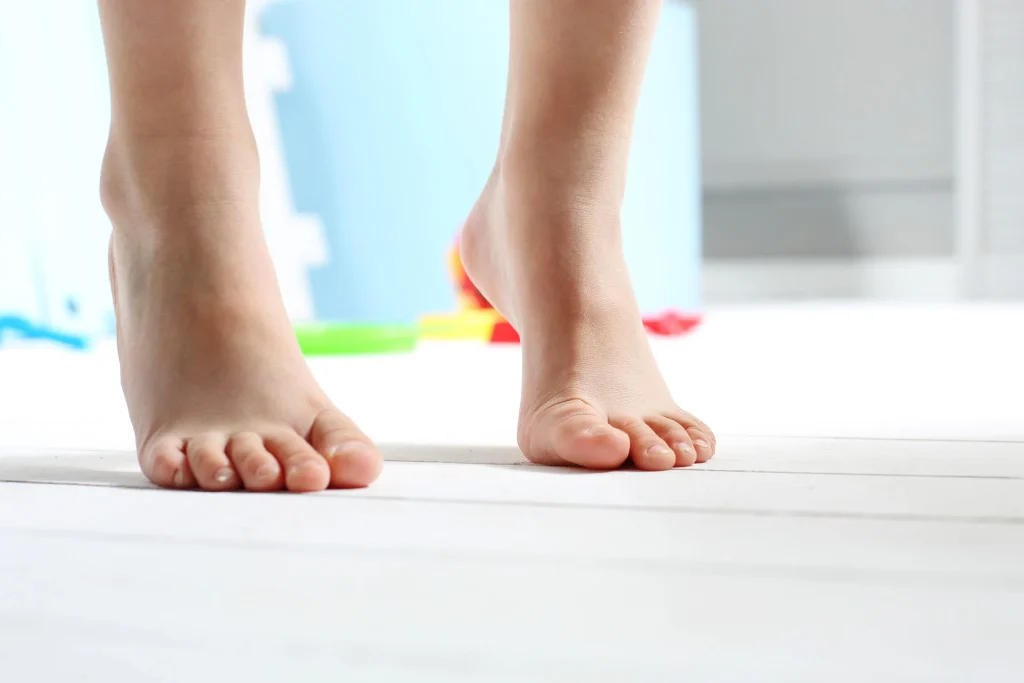
Can physiotherapy help children who walk on their toes?
This is a common question asked by parents who seek help when they notice that their child has been walking on their toes from their very first steps and continues to use this unusual gait pattern during the following months of development.
Around their first year of life, children begin to walk independently, initially with a wide base of support and relatively stiff knees, while placing the entire foot on the ground. Occasionally, a child may walk on their toes, but they will usually stop doing so relatively soon because it is not an energy-efficient way of walking. This typically happens around the age of two. However, approximately 7–24% of the typically developing population continues to walk on their toes.
When there are no significant neurological conditions, such as mild cerebral palsy or autism, this type of gait is referred to as idiopathic toe walking, as its cause is unknown. In recent years, a positive association has been reported between idiopathic toe walking, delayed speech development, and learning difficulties.
If your child:
- Has no history of prematurity or neurological disorders
- Has achieved their developmental motor milestones within the expected timeframes, and
- Began walking on their toes when they first started walking,
then they may potentially have the idiopathic form of toe walking.
If toe walking becomes habitual, this abnormal gait pattern can shift the child’s center of gravity, making it easier for them to lose their balance, stumble, and fall. This habit can create difficulties in gross motor development and, consequently, in acquiring skills such as standing on one leg, kicking a ball, and going up and down stairs.
The longer children walk on their toes, the tighter the muscles of their legs may become, particularly the gastrocnemius muscles (calf muscles). In an attempt to stand with the entire foot on the floor, the child may develop hyperextension of the knees, accompanied by noticeable equinus positioning of the lower limbs.
These children generally respond well to physiotherapy. Depending on the individual case, physiotherapy may include:
- Stretching and strengthening exercises
- Taping
- The use of walking orthoses
- The use of night splints
- Manual therapy
- Gait training
- A home exercise program
Ask your physiotherapist about an exercise program that you can follow at home. It is important for the exercises to take the form of play and be enjoyable for the child.
Calf muscle stretching exercise
The photograph shows an exercise for stretching the calf muscles. It is important to hold the child’s foot at the heel with your hand for better results. The knee should remain straight, and the stretch should be maintained for at least 45 seconds.
Eiff, M.P. & Zegar Judkins, D. (2006). What is the appropriate evaluation and treatment of children who are “toe walkers”? The Journal of Family Practice. 55, 447-450.
Tidwell, Μ. (1999). The Child with Tip-Toe Gait. International Pediatrics. 14(4), 235-238.
Cincinnati Children’s Hospital Medical Center Evidence-Based Care (2011). Guideline for Management of Idiopathic Toe Walking.